
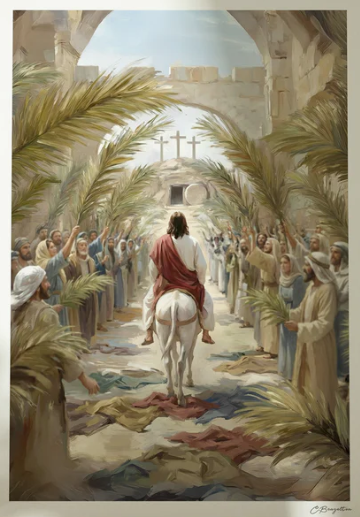
‘Triumphal Entry #2’ by Chris Brazelton.
I remember at some point in my life someone asking the question about the Triumphal Entry of Jesus into Jerusalem “I wonder if the donkey thought that this huge, excited crowd were cheering for him”. It’s funny what you remember and what you forget. It has stayed with me as a whimsical reminder of our role and posture as the church in the world. And as a pastoral leader among God’s people. As I have prayed while writing this, I believe the events of the Triumphal Entry is also a wonderful word of encouragement and invitation to the Vineyard, my church family of 38 years this month.
I realize most of you reading this will be familiar with this key event in the life of Jesus that begins ‘Holy Week’, the last week of his earthly life leading to crucifixion. And most of you will have experienced various practices churches do to celebrate ‘Palm Sunday’. And hopefully some of you are new to faith and church, eager to press into the full experience of Easter. Let’s dig into the story.
It is interesting that all four gospels record the Triumphal Entry with some variation (Matthew 21, Mark 11, Luke 19, John 12). The early church must have thought it was both historically significant and theologically rich. I am going to focus on the narrative from Luke, for only he records an event at the end of the procession which is important for our focus in this reflection.
Jesus is staying in Bethany at the home of his good friends Lazarus (who he raised from the dead), Martha and Mary. While walking with his disciples into Jerusalem one morning, a journey of 2 kilometers, they stop halfway near the town of Bethphage. Several key things happen here. Jesus directs two of his disciples to get a donkey and her young colt, and to simply say to the bewildered yet obedient owner “the Master has need of them” (I have tried this on several occasions when needing to borrow something nice with varied success). The next morning Jesus would curse a fig tree near here because of it being barren, interesting as Bethphage means “place of unripe figs”.
Only Matthew records 2 donkeys as he leans into his Jewish listeners with a literal interpretation of the Hebrew parallelism found in our key prophecy of Zechariah 9:9 “Rejoice, O people of Zion!” Shout in triumph, O people of Jerusalem! Look, your king is coming to you. He is righteous and victorious, yet he is humble, riding on a donkey—riding on a donkey’s colt.” NLT
I have landed on this idea that the mother was chosen to be there to comfort the colt and help it to remain peaceful and steady as the Prince of Peace rode through the chaotic crowd. Perhaps the detail of 2 donkeys wasn’t important to the other gospel writers. While talking to my 10-year-old granddaughter Athena yesterday who lives in Argentina and whom we had just visited, I posed this apparent Bible conflict and my theory for two donkeys. She agreed with me 100% and did speak out of some experience as she has been taking horseback riding lessons and has been around horses of various ages seeing their reactions to sound and motion.
It is the week of Passover and thousands of Jewish pilgrims have come from all over the world. They begin to take notice of what is happening around the prophet from up north, a hugely popular figure among the masses for his miracles and the raising of Lazarus, but still an ‘outsider’ heading to the home territory of the ‘insiders’. They focus the familiar singing of the ‘Hallel’ (Psalms 113-118), often sung to welcome pilgrims during the week of Passover, towards Jesus. They get very excited as they sense prophecy may be being fulfilled before their very eyes. They shout and sing “Hosanna to the son of David. Blessed is the one who comes in the name of the Lord. Hosanna in the highest!”
The disciples begin to take off their outer tunics, two of them having first padded the young colt to make it more comfortable for him and Jesus. The rest begin to ‘roll out the red carpet’ by laying down their cloaks and quickly making a beautiful pathway to Jerusalem. Others ran to the fields to cut leafy branches and wave them in joyful procession. The children are jumping, dust is flying, arms are waving, voices are singing, Pharisees are screaming. Jesus, fully living in the moment, responds to the angry religious leaders “Sorry guys, but if they keep quiet, the rocks you are standing on will start dancing and singing!”
What a range of emotions Jesus and the disciples would go through during these hours. Next, only Luke records that as Jesus views his beloved Jerusalem and the crowded streets, he breaks into sobbing knowing they will largely reject him, arrest, torture and crucify him. He is weeping not so much of what will happen to him but that his people are blind to God’s visitation. He prophecies to the city and his confused disciples of its coming downfall and destruction which would happen only 40 years later in 70AD. Following this, he enters the Temple courts, makes a whip, and drives out the money changers calling for God’s house to be a sanctuary of prayer. Can you imagine the crazy and exhausted conversations at the end of this day back at their home base in Bethany?
All week as I have thought about these events, I kept on hearing “lifting up and laying down”. I believe this is a distinct call to the Vineyard and how we make our way in the world. We are called to the practice of lifting Jesus up in our worship together as a first priority and then laying down our cloaks of pride, ego, self-protection, control, fear. Laying down our lives in service of others. Humble leadership. This often includes tears. For better or worse, we are a crying movement. It’s how we began. It’s how we continue. As I told a newcomer several Sundays who was experiencing the Holy Spirit for the first time “it’s okay, most of us have cried a lot here, I stopped wearing mascara my third week”.
I remember vividly 38 years ago this month, a group of us from Halifax traveled to Birmingham Alabama for a Power Evangelism Conference with John Wimber. Danny Daniels from Denver is leading us in “Hosanna” a celebrative worship song that had been recently written by Carl Tuttle, worship pastor at the Anaheim Vineyard. The melody and lyrics washed over me “Hosanna! Hosanna! Hosanna in the highest! Lord, we lift up your name with hearts full of praise. Be exalted oh Lord my God, Hosanna in the highest!” It was a week of lifting up and laying down as I heard the words many of us have ‘welcome home, this is your family’.
The following summer we were in Anaheim for the Vineyard pastors conference and after one session, John Wimber settled himself in a chair at the back of the sanctuary and several hundred of us lined up for prayer from him. What would he say? What would he pray? Where did he get the energy? I remember him looking at me in a fatherly way, placing his hands on me and giving me a short blessing “I pray that Jesus may be lifted up in the community that Larry (name badge) serves in and not himself.” A pretty good prayer and one I have not forgotten.
As we join believers from around the world this Sunday March 29 on Palm Sunday let us lift our voices in holy abandon and lay down everything once again for the sake of the gospel of the Kingdom.
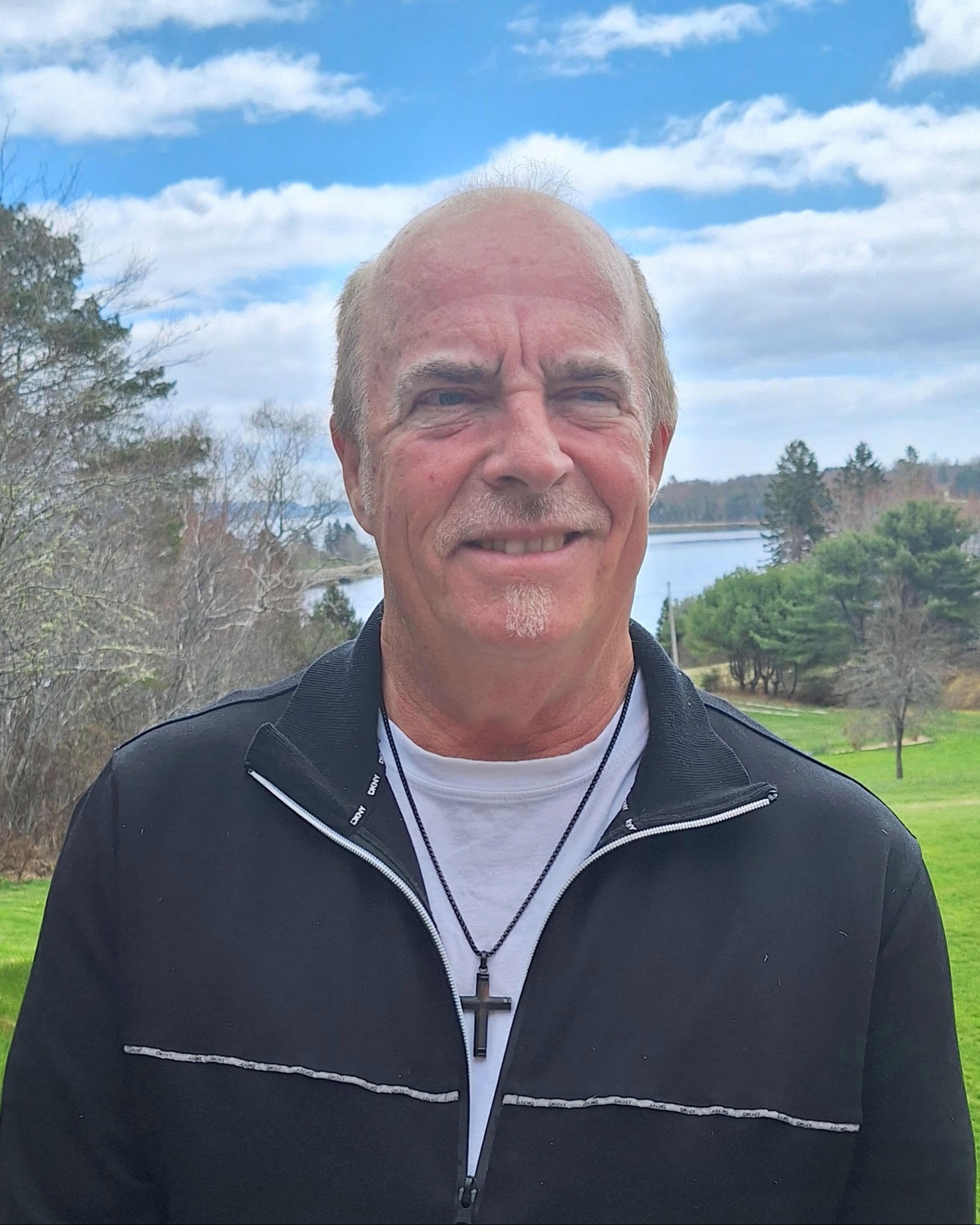
Larry Levy, along with his wife Karen, have pastored the Halifax Vineyard for many years and have recently ‘pivoted’ from this role. For the last several years, Larry has been a member of both the Listening Team and the Succession Team for Vineyard Canada. He is presently the facilitator for VLE (Vineyard Leaders Essentials) for the Halifax Vineyard and the Canada/US Vineyard Partnership Coordinator for East Africa. And yes, there has been an active Scrabble board on their kitchen table since the beginning of Covid.