
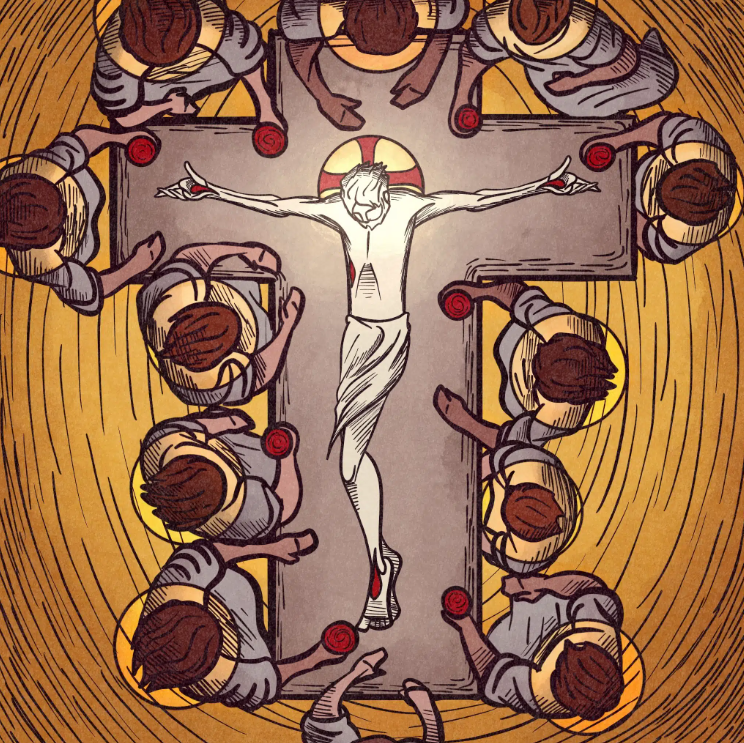
“John 19:14” by Full of Eyes
Already having used clandestine means to enter the city of Jerusalem at the beginning of what we call Holy Week – a simple “the Master needs it” code phrase securing the donkey on which he would make his entrance to Jerusalem, fulfilling the prophecy of Zechariah 9 – Jesus once again gives his disciples a pre-arranged “spy call-sign” of a man carrying a jar of water inside the city walls – typically woman’s work – which would let them know he was the one who would provide a secure room for them to meet in for their observation of the Passover Seder, and where they could have the secrecy needed to discuss what Jesus was up to in the city.
Such intrigue.
Jesus is up to something. But, as would become clear, the disciples are incapable of truly understanding what it is exactly. Believing that Jesus was the promised Messiah and laying all aside to follow him, they still were blinded by a preconceived belief that the Messiah of Israel would fulfill His role as Prophet, Priest and King through some triumphant fusion of religious fervor and political power, and believed Jesus was the One. Their Neo, if you will, who would liberate them from the matrix of Roman oppression and power, setting them free from all other pagan power forever, establishing Israel as God’s chosen nation once and for all. Amen.
Yet from the moment they entered this secret room they couldn’t comprehend the shadow of the cross that was already cast upon all of them and how central it was to framing the entire work, ministry and mission of Jesus. How key it would always be to understanding and following in His Way. The whole vibe of their time together at “the Table” was cruciform, and they didn’t like it.
Upon entering the room Jesus has immediately sent away the servant present to assist them and has taken that role upon Himself. He wraps a towel around his waist and, getting low and humble before each one of his disciples, starts washing their feet. More than being uncomfortable and unusual, this has set in motion something liminal and revolutionary that has the disciples completely disoriented – yet again – as to who Jesus is and who they believed Him to be. Peter especially – waffling from refusing to be washed to declaring that Jesus washes not only his feet but his hands and head also after Jesus rebuked him saying, “unless I [you let me] wash you, you have no part with me” – is profoundly disturbed and left pondering references to crowing roosters and a thrice denial.
The ensuing meal experience was one that continued to upend the disciples’ understanding of the mission of Christ, their role in it and the observance of Jewish tradition. Just as the securing of the beast of burden a week earlier and the encounter with the “water jar man,” Jesus continues to make distressing statements and behaves in a somewhat mysterious manner, both in his interactions with people around the table – particularly Judas – and as He facilitates the observance of the Seder.
He speaks of betrayal. He identifies himself with the various elements of the feast. He is the body. He is the blood. He declares that a new covenant is now set in motion that would be secured by His life being poured out for many resulting in the forgiveness of sins. All pointing to this cross, with which he seems obsessed.
Remarkable. What are the disciples to make of all this?
The longer the meal lasts – the more prevalent is the shadow of this impending cross. Yet, for the disciples, the promise of walking in this shadow and still fearing no evil seems to be out of reach. Jesus had called them to walk in the light so that the darkness would not overtake them. It would seem that darkness had already swallowed one sent out with a whispered, “what you are about to do, do quickly” and thirty pieces of silver waiting for him. But could even those who remain recognize the light that was shining right before them, or were they like those who were His own but didn’t actually want Him? Those who didn’t truly recognize Him?
About to leave this Table and begin the arduous step by step path that would take him through the stations of the cross and onto what several New Testament writers and preachers would call “the Tree,” Jesus declares, “[Now] love each other as I have loved you.”
Could this really be what it is all about or is this just another spy-code and means to another end? Is the servant life and sacrificial death of Jesus some kind of test and preparation for the real thing to come, or actually what it is all about? Could this be the shape of the love Jesus calls us to embrace? One that is cruciform in posture, deed, relationships and perhaps even physical death for the sake of others?
This is a revealing love. A light that shines in the darkness and one that cannot be overcome. Yet this love-light that shines in the darkness is not only one that is resistant to the pernicious, relentless encroachment of the shadows of death – of the evil that Jesus teaches us to pray to be delivered from – but it is the wisdom and power of God that is victorious, and actually eternally overcomes the pervasive darkness until it is banished forever. We are instilled with hope, even if it would seem that this dark evil is prevailing. We can see the ever present, ever advancing Kingdom of Love making all things new, for we see the One who holds it all. In the shadow of the cross, seated at the seder of Jesus, we can see the Love that remains. Do we dare to look? Dare to believe that this really is the Way to our redemption and eternal freedom?
So we too get up from the table and find ourselves here. On Good Friday. At the foot of the cross. Paul captures it this way approximately 30 years later in his Colossians epistle,“… having disarmed the powers and authorities, he made a public spectacle of them, triumphing over them by the cross.”
Oh for eyes to see and ears to hear that what looks so tragically bad is truly good. No longer cryptic symbolism or some form of an encoded parable to stretch our thinking and expand our hearts, we look up and actually see Him on a tree. Love pierced. Love bleeding and broken. No more symbolism. No more prophetic interpretations. It is here we find Him. Incarnation tragically, beautifully hanging on a tree. Victorious.
Good Friday indeed. And it is the good path; it points us to that which we must choose if we are to find rest for our souls. We come to our eucharistic table – this Table of Jesus – again and again, to remember – to follow – Him. Broken body. Shed blood. Each day we deny ourselves and take up a cross – our cross – to be like Him. Broken for others. Living out a love that bleeds. One practice informing the other. A rhythm of rest, repentance and resilience – able to sustain this journey along this narrow way. The good way. From the table to the tree. Following in the steps – the Way – of Jesus.
Step by step.