
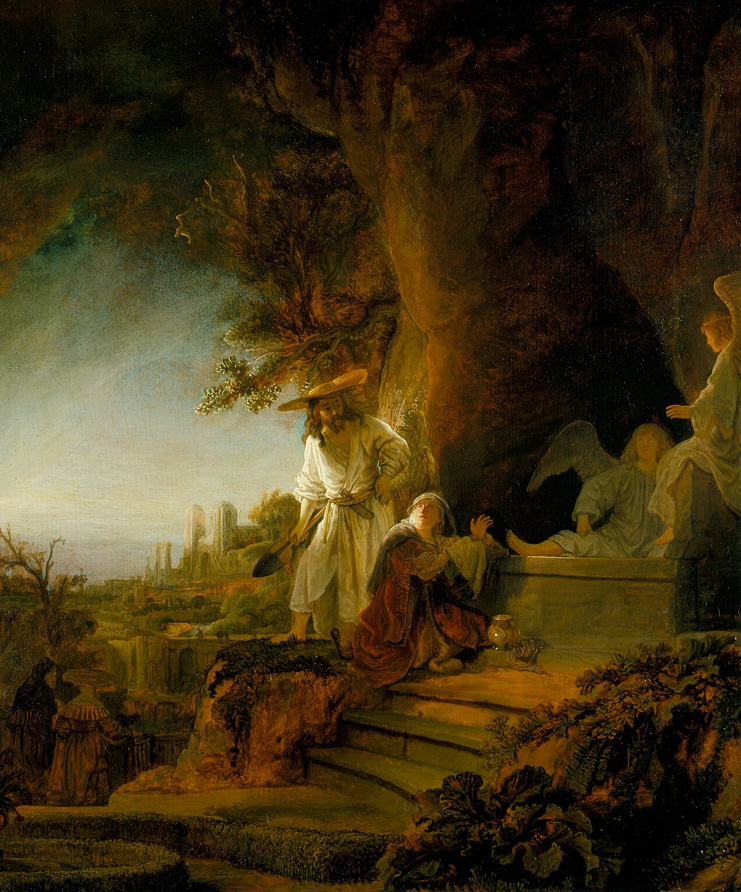
“The Risen Christ Appearing to Mary Magdalene” by Rembrandt
I have often wondered, where does Holy Saturday end and Easter Sunday begin? At midnight of Sunday? At the empty tomb? When did the resurrection actually happen? I ask these questions because, as I have read the Gospel accounts of this miraculous, joyous, and wondrous event, some of the first human encounters with the resurrection of Jesus certainly do not carry the same celebratory nature that most of us have come to expect in our Easter church services. Within the Scriptural accounts of this day, there are multiple expressions of confusion right alongside the emotional experiences of acute grief—tears and weeping, shock and bewilderment, loneliness, anxiety, and doubt. Cognitive dissonance on a physiological level. I think any psychologist will tell you that these are some of the most natural human responses to loss, and they all have a place, even when face-to-face with a miracle.
Easter Sunday begins where Holy Saturday ends: the second sunrise after a horrific day and on the heels of staggering loss. It is perhaps because of my own journey but, in recent years, my imagination has been utterly captured by the first eye-witness to Christ’s resurrected body, Mary Magdelene. John’s account reads, “early on the first day of the week, while it was still dark, Mary Magdalene went to the tomb…” (John 20:1). As is so common for the bereaved, helplessly awake at all hours, Mary arrives at the tomb before daybreak, grief-stricken and literally clutching the embalming spices of death (Luke 24:1). Mary isn’t coming to the tomb hopeful and expectant, she is holding vigil. When she sees the stone removed from its place, her first thought isn’t a miraculous resurrection of the dead but a violation of her deceased Lord’s body. Surely this was grief upon grief for her.
Confusion ensues, along with the back-and-forth and back-and-forth nature of communicating events that are clear to no one in these moments. Mary returns to Jerusalem and shares breathlessly the news with the disciples, “They have taken the Lord out of the tomb, and we don’t know where they have put him (John 20:2)!”
Luke states that the disciples are in disbelief at the absurdity and “nonsense” of her words, but Peter and John take off running towards the tomb (Luke 24:11). The way in which the text reads, it is like all of them take turns standing disoriented, mouths agape, before Jesus’ grave clothes, scarcely knowing what do. In the end, John states that they “believe” but did not yet fully understand why Jesus had to rise from the dead (John 20:4-8). Luke’s account also gives insight into this confusion, saying that “Peter…got up and ran to the tomb. Bending over, he saw the strips of linen lying by themselves, and he went away, wondering to himself what had happened (Luke 24:12).”
Wait, the disciples just, leave?
Mary is left utterly alone, and she collapses in her grief and confusion, weeping.
It is in this emotional and physical state that the resurrected Jesus appears to her and is it any wonder she doesn’t recognize him? In this moment, I think Mary is holding multiple traumas in her body: the trauma of witnessing Christ’s violent death, the trauma of what she perceives is the robbery of his deceased body, and the trauma of emotional abandonment. Even in the midst of a fresh reality that is glorious on a cosmic scale, Christ’s resurrection is first announced within the context of bewildering grief, and it actually takes more than a minute for it to sink in.
I have a print of Rembrandt’s depiction of this scene that hangs above my desk as I write this—we know how this story ends. Jesus asks Mary, “why are you weeping?” and there is not a hint of recognition in her response. She believes he is the gardener. Rembrandt’s painting is rich in symbolism, but I especially love how he cloths Jesus in the cultural outfit of his time. Christ wears a floppy hat and plain attire, clutching a shovel. Mary has no glimmer of even recognizing the tone in his voice and responds distraught and overwhelmed: “Sir, if you have carried him away, tell me where you have put him (John 20:15).” It isn’t until Jesus speaks her name, “Mary,” that she turns in shock and awe and perceives him as Jesus. Rembrandt shows the instant of realization in the light and illumination over her face. I imagine this to be such a tender moment between the two of them. The Lord drawing close, calling her by name, and Mary clutching onto him, crying tears of relief and astonishment. In the historical church, Mary has long been revered and honoured as the, “Apostle to the Apostles,” the first person to proclaim the Good News of the risen Christ: “I have seen the Lord!” (John 20:18)
For many churches, both past and present, from the beginning of Lent until Easter Sunday, all liturgical readings are void of the word, ‘Alleluia.’ I find it significant that over these 40 days, in both word and practice, the historical church has demonstrated a corporate and communal restraint from rushing into the glory and joy of the resurrection. Even in the most immediate encounter with the risen Saviour, Mary meets Jesus in the midst of her own grief, not outside of it. Today, however cautious, laden, or mournful it comes, we cry aloud in exhale and exclamation, ‘Alleluia, He is risen, indeed.’
A LITANY FOR EASTER MORNING
Morning has broken and the earth stirs in the first flickers of light.
God’s shining and glorious new dawn is on our horizon.
Watch as it grows brighter, and brighter, then brighter still,
Illuminating and stretching into a sorrowfully quiet and reeling world:
Into the pain, heartache, groanings, and staggering confusion.
Into the stunned silences where all of our hopes lay shattered.
Wait.
Breath in the sun-lit air.
Lift up your faces.
Look.
Christ the Lord is risen today,
ALLELUIA!
Christ rises and His risen life meets us here:
Tomb-side in the garden alone and afraid.
Here, in the bewilderment of devastating grief.
Here, in the turmoil and anguish of our hearts,
Love still knows our name.
CHRIST’S RISEN LIFE MEETS US HERE.
Christ has lived,
EMMANUEL, OUR GOD WHO IS NEAR.
Christ has died,
SAVIOUR OF THE WORLD, OUR WOUNDED HEALER.
Christ has risen.
HE IS RISEN, INDEED!
Life, oh blessed Life: awakened Life, risen Life, victorious Life, resurrected Life, triumphant Life, full Life bursts forth from the tomb this morning. From dark, shadowy, and lonely places, from cold, dead-and-finished bones.
OUR LORD IS ALIVE!
Jesus, our Lord who suffered at the hands of a violent world. Jesus, our Lord who has triumphed over the same systems of power and violence. Jesus our victorious conqueror, who overturned death itself without raising a sword. Precious Saviour, You held us to the end, and You hold us in the rising.
CHRIST’S RISEN LIFE MEETS US HERE.
Christ has lived, Christ has died, Christ has risen,
HE IS RISEN, INDEED!

Erika Britt Kobewka is a wife, mum, writer, worship leader, spiritual director, and violinist from St. Albert, Alberta. As a long-time creative contributor within the Vineyard Canada family, ‘setting the table’ for others to experience the love of God continues to be a profound joy and privilege. Erika is an avid reader, hiker, and (amateur) flower gardener. She loves to be at home with her family or finding new trails in the Rocky Mountains. She and her family attend and serve at Avenue Vineyard in Edmonton. You can follow some of her written work at www.erikabritt.ca .