
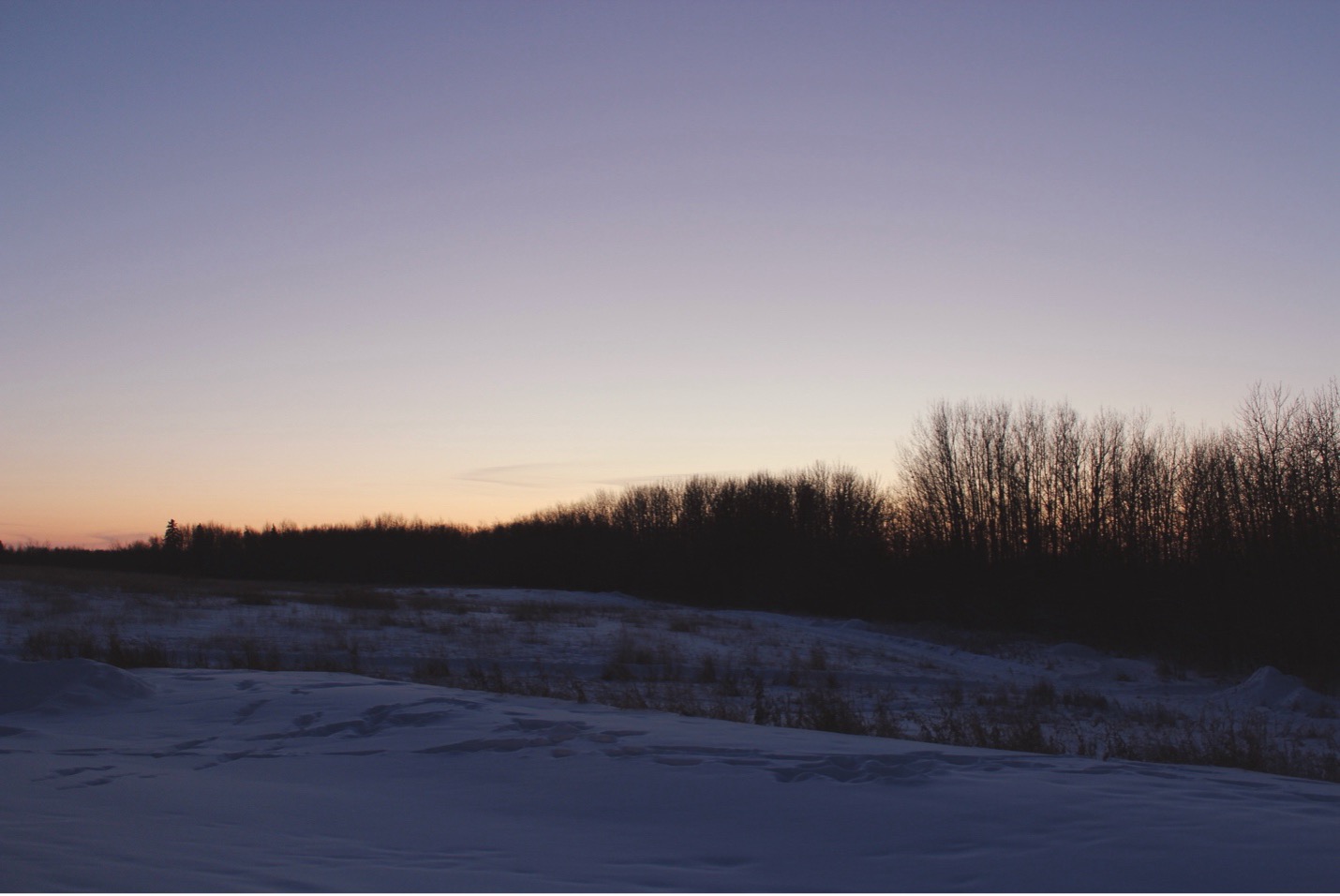
‘Last Light’—Winter Solstice, 2025: St. Albert, Alberta
Every year, despite the steady regularity in turning the calendar month by month, Advent seems to arrive out of nowhere and takes me by surprise. For the liturgical Church, the first Sunday of Advent has always marked the beginning, not the end, of the Christian year. And so today, as the Cycle of Light begins, we are actually stepping over the threshold into a new year, ready or not.
Advent means ‘arrival’ and by its very nature, it holds three distinct realities simultaneously:
- Jesus, God-in-flesh and Saviour of the world, was born at a distinct time and place in history.
- Jesus inaugurated and embodied a new Kingdom that will have no end, and we see shimmers of this Kingdom, day by day.
- We are still waiting and longing for the culmination of that promised Kingdom.
We may cognitively hold these truths together, but I think they are constantly held in tension. In the same way Israel longed for a Messiah who would set them free from oppressive systems of power and violence, we too are waiting and in need of rescue. In a world fraught with brokenness and suffering, we too reach for a Saviour who, instead of clutching onto equality with God, entered the world by way of vulnerability, humility, and need.[1] Christ knows our human fragility and is acquainted with our grief and yet one of the painful spaces of our faith, is that we still reside in an aching reality of hope differed. The prophetic voice of Isaiah that swells with anticipation and hope also holds painful truths for those who are still groping their way through the valley of shadows. “The people walking in darkness have seen a great light; on those living in the land of deep darkness a light has dawned.”[2]
We are still waiting. We are still longing and yearning for the Light of Christ to break into the darkness of our world. This is the stuff of Advent, and it hurts.
Over the past few weeks, as we have collectively begun our yearly passage through the darkest days of the year, I have recalled a childhood memory. I grew up in a small community in the Northwest Territories, and during the winter months, my older sister and I walked to school in the dark. I don’t remember being afraid, not even if I had to do the trek on my own. I was a daydreamer and easily distracted and I would often pause at the mound of snow removal stacked high and aglow with the streetlights. To my active imagination, it was a castle of snow dreams and after school, it was commonly swarming with kids. By 3:30 in the afternoon, it was already dusk but there we would stay—a herd of Northern kids, playing in a parking lot on a monstrous crag of snow, oblivious to the backdrop of an early setting sun. The streetlights would buzz awake for another long night and still, most of us wouldn’t scamper home for dinner until much later.
Now, as a grown-up, there are parts of these quiet winter days that I savour and enjoy but there is also a pervasive silence in the dark that is unnerving. The quiet of the night holds its own vulnerability—it seems to accentuate a fragile solitariness in the human journey. It is in the dark that we perhaps feel the most alone. It is in the quiet stretches of the night that our thoughts can have a propensity to race and fret. I don’t think it is uncommon for all of us to experience a melancholy this time of year. We often counter these feelings with comfort activities like lighting candles and decorating our homes with twinkle lights or we try and get daylight into our eyes within the first few hours of waking. For any medical or mental health professionals, the winter months (particularly for those of us in the northern hemisphere) see an uptick in seasonal affective disorder (SAD), loneliness, and depression.[3] There are physiological and psychological shifts within us as we move from autumn to winter and experience a lessoning of daylight. I have wondered if that is why parts of our culture lean so heavily into things that sparkle and shine and make loud noises this time of year—are we uneasy in the silence of this season?
The dark can be peaceful and calming and it is also bleak and disorienting. Have we not felt a rush of memory in the quiet? Or, in a moment of stillness, experienced a sudden unearthing of deep longings, painful losses, fears, and disappointments?
There is a beloved Christmas carol that in both tonality and lyric seems to capture the heartache and tender hope of this season:
“O come, O come, Emmanuel,
And ransom captive Israel,
That mourns in lonely exile here,
Until the Son of God appear.
Rejoice! Rejoice! Emmanuel,
Shall come to thee O Israel.”
This carol dates back to monastic communities of the 8th century, and the haunting minor melody was based on the O-antiphons—7 Advent prayers chanted during Vespers (evening prayer) in the final week before Christmas.[4] I find this remarkable and beautiful—that the rhythms of Advent spanning across centuries of time for the historical church, continue to orient us today. Dr. Jeremy Begbie, a renowned theologian and musician calls music “the language of longing,” and he suggests that all melody has the capacity to reveal deeper spiritual desires in all of us—a yearning for home.[5] That feels like Advent. Today, as we sing our prayers into the dark and light wax tapers, as we honour and hold-space for personal and communal realities of grief and pain, as we dare to whisper our longings out loud, and as we stagger into this season weary and burdened, may the Hope of Christ’s coming, meet you where you are and as you are. Emmanuel, God is with us.
_____________________
[1] Philippians 2:6, NASB
[2] Isaiah 9:2, NIV
[3] The Mental Health Impact of Canada’s Winter: Beyond Seasonal Affective Disorder
[4] O Emmanuel (God with us), O Sapentia (Widom), O Adonai (God), O Radix Jesse (Root of Jesse), O Clavis David (Key of David), O Oriens (Dayspring), O Rex Genitium (King of the Gentiles)
[5] Beholding the Glory: Incarnation Through the Arts edited by Dr. Jeremy Begbie

Erika Britt Kobewka is a wife, mum-of-3, writer, worship leader, spiritual director, and violinist from St. Albert, Alberta. Offering spiritual direction and companioning others in their journeys with Jesus continues to be a profound joy and privilege. Erika is an avid reader, hiker (particularly along wooded paths close to home), music teacher, and amateur flower gardener. She and her family attend and serve at Avenue Vineyard in Edmonton. You can follow some of her work at www.erikabritt.ca.