
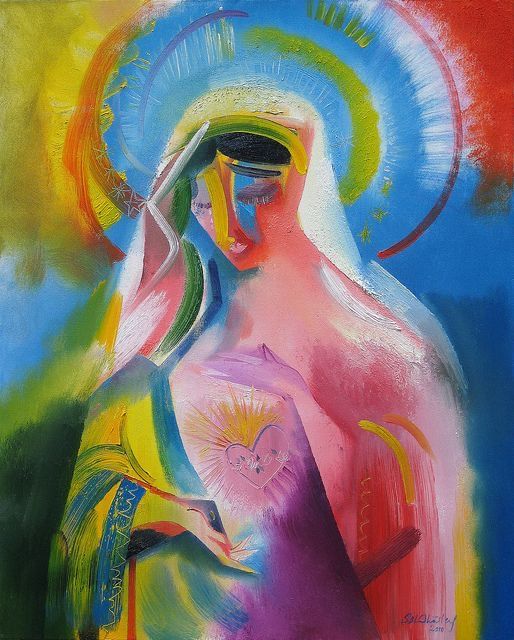
Artwork: “Immaculate Heart of Mary” by Stephen B. Whatley.
Words of the prophet Isaiah have been echoing in my mind like the tolling bells of an ancient cathedral this advent – beckoning – calling. Awakening?
“Comfort ye, comfort ye my people, saith your God.” (Isaiah 40:1)
I know, I know, it’s King James English, but you can’t just get the classical out of this Royal Conservatory trained pianist and charter member of the Calgary Boys Choir who saw himself one day performing in the Opera.
“Comfort ye, comfort ye my people, saith your God.”
Can you hear the undulating strings of Handel’s Messiah in an ebb and flow with vocal lines at times mimicking and at others swelling with the peaks and troughs of the melody in the background? It is the second piece of music in Handel’s Oratorio but the first time we hear a human voice in this masterpiece of Handel’s. A tenor voice rings out in this Accompagnato, much like the prophetic literary moment in the Isaiah text. Stark – singular – compelling.
“Comfort ye, comfort ye my people, saith your God. Speak ye comfortably to Jerusalem…”
To shift gears to a slightly more modern rendition in the NIV, “speak tenderly.” דַּבְּר֞וּ עַל־ לֵ֤ב “dabbrū ‘al-lēb” which literally means “speak to the heart.” “Speak to the heart” is a Hebrew idiom, hearkening to the story of Joseph comforting his brothers after their father’s death. “Joseph comforted them and spoke into their heart.” (Genesis 50:21) It means to comfort, encourage, or say tender, persuasive and affecting things that reach a person’s deepest inner being. It is often associated with words of compassion, understanding, and the intention to heal or reconcile. At its core, “dabbrū ‘al-lēb” is to speak kindly. I can’t help but hear resonance with Romans 2:4. It is the kindness of God that leads us to repentance.
Unlike modern Western culture where the heart is often seen as the seat of emotion in opposition to the rational mind – i.e. use your head and not your heart – the Hebrew concept of “heart” (lev or levav) refers to the entire inner person. It is considered the control centre – the operating system if you will – of one’s whole being, integrating intellect, emotion, and the will.
Speak tenderly. Speak to the heart.
“Don’t be afraid Mary; [the angel says] you have found favor with God. You will conceive and give birth to a son – you are to call him יֵשׁוּעַ – Savior!” (Luke 1:30)
Favor – χάρις. A very ancient and common word with a variety of applied meanings. They all come from the notion of sweetness, charm, loveliness, joy, delight. Interestingly, just as we find kindness at the core of the understanding of dabbrū ‘al-lēb, kindness is key to understanding χάρις, especially of God towards humanity as here in this text. (Robertson, Archibald Thomas. Word Pictures in the New Testament. B&H Academic, 1933.)
“Don’t be afraid. You have found favor.”
Resonating with the words of the prophet some 700 years later, Mary can hear this χάρις, this tender voice of God, and is moved deep within her heart. Fear dissipates. Shalom comes. Surrender results.
“I am the Lord’s servant,” Mary declares, “let it be.” (Luke 1:38)
The same Spirit that brought life and light out of darkness in Genesis chapter 1 is going to generate life inside her womb. God is about to bind himself to humanity through the conception and the birth of יֵשׁוּעַ – Saviour. Mary is overwhelmed. Overshadowed.
Even after the birth of Jesus, in the midst of angelic sightings, shepherds curiosity and wonder, and the swirl of gossip, chatter, conspiracy and amazement that was quickly spreading all throughout Bethlehem, Mary held onto God’s tender word(s) to her and “treasured up all [these things] and pondered them in her heart.” (Luke 2:19)
Speak tenderly. Speak to the heart.
One is hard pressed to find another way to speak tenderly to the heart than through this beautiful story – and reality – of mother and child.
Jesus comes to us through the humble and gentle consent of Mary as she agrees to cooperate with the mystery and wonder of the gestative work of the Spirit in conceiving the Christ child within her womb.
יֵשׁוּעַ The Saviour arrives tenderly – lowly. Swaddling clothes in a manger and it is this that is the sign.The σημεῖον. Not the angelic host. Not the star. It is the way the Messiah has come that is the miracle. The sign miracle. The wonder.
Oh how we need to hear the tender, comforting, “straight to the heart” voice of God in our time. We must attune ourselves to hear the kind timbre, intonation and cadence of God’s word to us. To our culture. To this world. It is in the listening that we will be led to the repentance that we need. It is in hearing this voice that our fear will be stilled and the courage will come to simply obey. Find trust and shalom for the soul.
Can you hear?
“Comfort ye. Comfort ye my people.”