
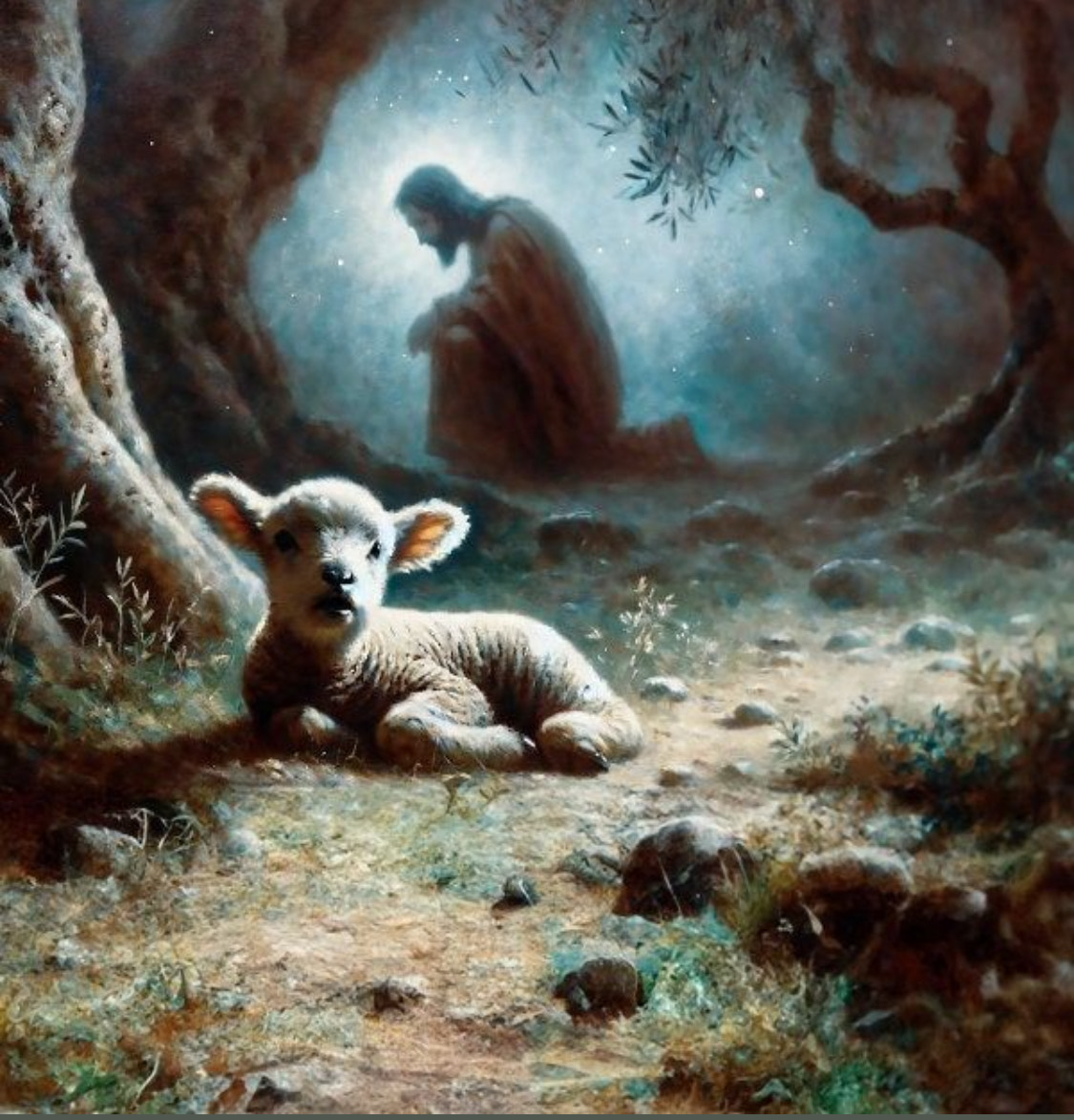
Artwork: “The Sacrificial Lamb” by Christian Art Expo
As a young man of 17, I had a joyful encounter with the Holy Spirit in which I found myself speaking in a language I had never learned—much like the new believers in the book of Acts. To my delight, I found a verse in Song No. 159 of my church hymnal that expressed the joy I was feeling: “What language shall I borrow, to thank thee, dearest Friend?” [1] That supernatural language is still bubbling in my heart today—more of a permanent loan than something borrowed!
And yet… if you are like me, as we gaze on the incarnate Christ during Advent we are still looking for language, for vocabulary to express appropriate wonder and worship to Jesus. How can it be: did God really become a man, and a little man at that? Did the Word truly become flesh? Do we have any category for this? Or at least a symbol? There are plenty of images in Scripture that symbolize Jesus’ death and resurrection, but what about the incarnation itself?
Our Bethlehem shepherd friends, keeping watch over their flocks at night, come to the rescue! Much can be said about their humble origins, and the marginalization they would have experienced based on their low social rank and questionable ritual purity. Yet they were chosen as the first witnesses – the first apostles of Immanuel, the newborn Saviour. They also carry an unspoken message, one found in their very vocation. God chose shepherds to remind us of… the Good Shepherd.
When Jesus uses this title for himself in John 10:11, he is pulling together a wealth of texts from the Hebrew Scriptures – Genesis, Exodus, 1 and 2 Samuel, Isaiah, Jeremiah, Ezekiel, Micah, Zechariah, and several Psalms. One psalm leads the way in its clarity, eloquence, and accessibility.
How do you pray Psalm 23? Do you think mostly of the Father as you address these familiar words to your Shepherd, or are you more aware of Jesus? Both answers are “correct,” and remind us that dialoguing with the Triune God is wonderfully bewildering. But just to confound us even more, have you ever considered that Jesus prayed Psalm 23?” Surely he did – after all, he prayed the preceding psalm as he hung on the cross, “My God, my God, why have you forsaken me?” (Psalm 22:1). So this Saviour whom we address as Shepherd and Lord also took his place as a man, as one of us, kneeling beside us. He prayed to his Father, and ours, “Lord, you are my Shepherd.” As he breathes that prayer, we hear the voice of… a sheep that trusts its shepherd.
Our Shepherd, also a sheep? What have we here? John the Baptist, that greatest of prophets, answers: “Behold, the Lamb of God, who takes away the sin of the world!” (John 1:29). In this proclamation, the Baptizer himself pulls in the voice of another rather significant prophetic voice, found in Isaiah 53:6-7:
6 We all, like sheep, have gone astray,
each of us has turned to our own way;
and the Lord has laid on him
the iniquity of us all.
7 He was oppressed and afflicted,
yet he did not open his mouth;
he was led like a lamb to the slaughter,
and as a sheep before its shearers is silent,
so he did not open his mouth.
Yes, our shepherd became a sheep. Even though we were straying, ornery, ungrateful sheep. God became one of us. The Word became flesh. The Good Shepherd became the Lamb of God. In light of this, the full quotation of John 10:11 reveals a fuller portrait than we may have perceived: “I am the good shepherd. The good shepherd lays down his life for the sheep.”
Perhaps this contemplation of our Shepherd-Lamb is better suited to Lent. Is Advent not the season to behold the cradle more than the cross? That seeming contrast disappears when we understand that Jesus’ self-giving did not begin in Gethsemane; it began in Mary’s womb. This is when “he made himself nothing, by taking the very nature of a servant, being made in human likeness” (Phil. 2:7). This is when he became the Lamb of God.
For thirty-three years Jesus gave of himself: he lived as a boy like you and I were boys and girls; he lived as a teenager like you and I were teenagers; he lived as a man like you and I are women and men. He suffered everyday hardships like we suffer everyday hardships. Yet Jesus suffered like no other in his culminating self-giving on the cross. In all this, he is the Lamb of God, and according to the apostle John’s other big book (Revelation!), he continues to be the Lamb of God—forever both Shepherd and Sheep; forever both the God we worship and yet human like you and me.
There are several profound, complementary ways of understanding Jesus’ death for us. One is “substitutionary atonement,” often associated with the suffering Lamb of Isaiah 53. Some people find this concept uncomfortable, and it doesn’t work as well if treated as the sole lens through which we see the crucifixion. Yet we can robustly embrace Jesus’ substitutionary death when we see it as more than a transaction or a cosmic checkbox: it is God saving us in person—giving himself and suffering what we deserved. At the cross we see the ultimate act of self‑giving, the same theme of self-giving we see in Jesus’ incarnation, in his very being, and throughout his life. Jesus has joined himself to humanity forever, saving us as one of us.
On this third Sunday of Advent, we light the candle of love. As we do so, our shepherd friends invite us to take a moment to consider this Good Shepherd who gives his life for his sheep. This shepherd loves us wholeheartedly, as he echoes his own words in John 15:13, “Greater love has no one than this: to lay down one’s life for one’s friends.” Shepherd and sheep, Lamb of God, and loving friend—now I have some fresh language that I can borrow, or even keep, to wonder and to worship Jesus Christ!
[1] Paul Gerhardt, O Sacred Head, Now Wounded (orig. German O Haupt voll Blut und Wunden); melody by Hans Leo Hassler; harmonization by Johann Sebastian Bach; English translation by James W. Alexander; Mennonite Hymnal(Faith and Life Press, 1969).
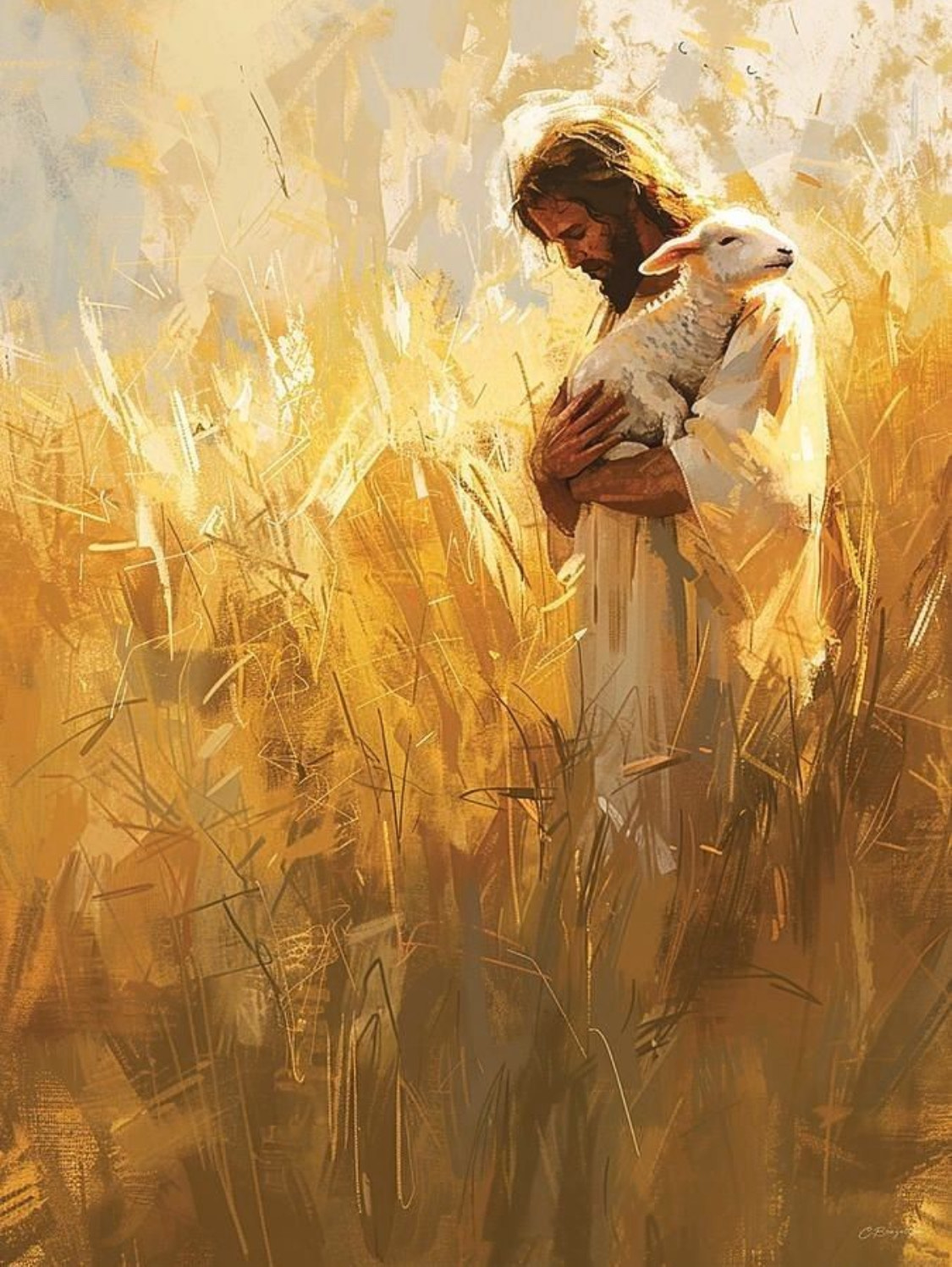
Artwork: “He Found Me” by Chris Braxelton, The Painted Gospel
Advent Communal Practice
For the third Week of Advent, beginning on Sunday, December 14, I invite you to a morning prayer. As we have reflected on the self-giving love of the Shepherd who became the Lamb, we are invited to a grateful response of self-giving.
In preparation, take a look at Psalm 5:3 (Amplified Bible): “In the morning, O LORD, You will hear my voice. In the morning I will prepare [a prayer and a sacrifice] for You, and I will watch and wait [for You to speak to my heart].” The word for “prepare” is sometimes used for arranging wood for a sacrifice, and sometimes for arranging troops for battle. The word for “watch and wait” is used to express expectant watchfulness, and sometimes describes the activity of a guard on a watchtower.
Set aside a quiet place and a handful of unhurried minutes. Perhaps your mind is “noisy,” but assume a body posture that aligns with a willing heart. Invite the Holy Spirit with a slow, heartfelt breath or two. Become aware that you are speaking to a person—your shepherd, your God, your friend who loves you. You have a verse that you would like to express to him.
As you pray Psalm 5:3, lean into the picture of a sacrifice. “Jesus, thank you for your self-giving at the cross. In love I give myself to you. Here is my body, a grateful and living sacrifice (Romans 12:1).”
You may want to present the various parts of your body to Jesus. For example, “Jesus, I give you my eyes. Help me to see what you are doing. I give you my feet – what adventures do you have for me as I walk around today?”
As you “arrange your sacrifice,” be watchful, expectant. The Spirit may have something encouraging to say about your feet, or your mouth.
Sitting as a prayerful sacrifice can easily fill the time you have set aside. But if you would like a second prayer direction, there is an invitation to consider soldier language in the wordplay of the Hebrew verbs. In Romans 13:12-14 we are invited to put on the “armour of light,” which is really about “putting on the Lord Jesus Christ.” As you talk to Jesus about the different parts of your body, you can acknowledge him as your protective armour for each one. This may lead you to pray Ephesians 6:13-18, where the “armour of God” is itemized. Each piece of armour is about Jesus, not some prayer technique.
Lord Jesus, I look to your leadership today. You are a good leader, a good shepherd. I am honoured to be your living sacrifice today. I am willing to be your soldier, walking in the shoes of peace, peace with those you send my way. They are not my enemy. Lord, come to me repeatedly throughout the day to remind me that you are walking with me. Jesus, you are God with us, God with me.
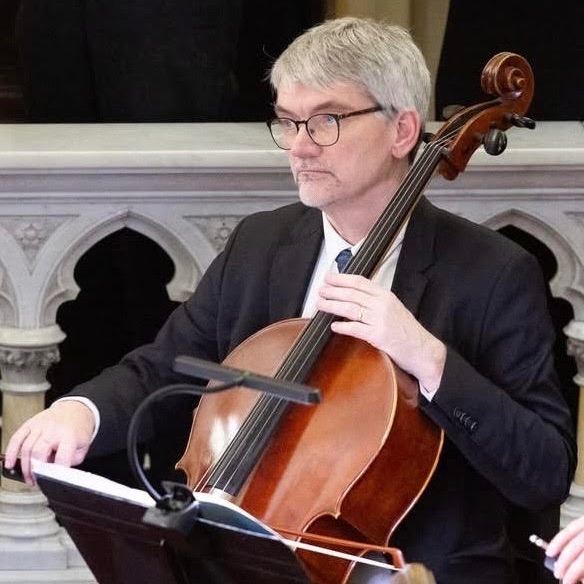
Peter Wiebe and his wife, Ruth, are the parents of six adult children and grandparents to thirteen grandchildren under the age of ten. They have been part of the leadership mix of Windsor Vineyard since 1988.
In addition to pastoring a church, Peter provides regional oversight for our East region. A longtime cellist with the Windsor Symphony Orchestra, he has also served as their associate conductor. He studies Hebrew in his spare time.